
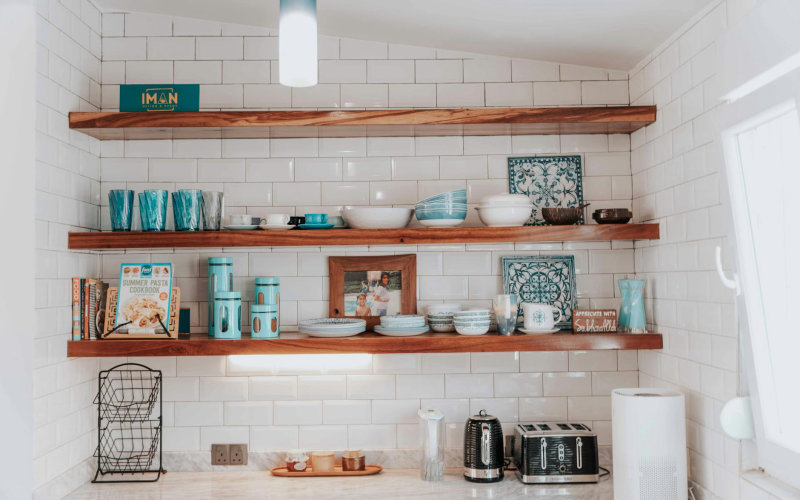

Open shelving is one of those things that looks absolutely stunning in magazine photos and absolutely catastrophic in real life. I’ve been there. Bought the floating shelves, arranged my stuff, stepped back, and thought—why does this look like a garage sale?
Here’s the thing: it’s not you. Nobody actually explains the mechanics behind those beautiful shelfies you see on Instagram. There’s real logic underneath the aesthetic, and once you get it, something clicks. Your shelves stop feeling like a storage dump and start feeling like an actual design moment.
So here’s what I’ve learned after years of rearranging, second-guessing, and finally landing on systems that genuinely work. Nine of them.
1. Edit Ruthlessly Before You Arrange Anything
This is step zero, and most people skip it entirely. Before you touch a single object, pull everything off those shelves and put it on the floor. All of it.
Now look at that pile. Half of it doesn’t deserve shelf space. Random objects accumulate on open shelving the way dust bunnies accumulate under a couch, and if you start arranging without editing first, you’re just organizing chaos.
A rule I picked up from interior stylist Emily Henderson (she’s been writing about this since around 2012): aim to display only about 30% of what you own. The rest goes behind closed doors. Sounds brutal. Works every single time.
2. Work in Odd Numbers
Three books, five plants, seven objects grouped together. Your brain reads odd-numbered groupings as deliberate and dynamic. Even numbers feel static—almost accidental.
And honestly, you don’t have to take my word for it. Test it yourself in five minutes. Put two candles on a shelf, then add a third. Notice how that third candle makes it look like a choice rather than leftovers?
Most professional stylists—whether they’re working with brands like West Elm or appearing on HGTV—will tell you the same thing. Groups of three are your starting point. Build from there.
3. Vary Heights Dramatically
Flat arrangements kill shelves. When everything sits at roughly the same height, your eye just slides across the whole thing like a bored student skimming a textbook.
What you actually want is drama. A tall vase next to a short stack of books next to a medium-height sculpture. A 2019 study from the Journal of Environmental Psychology (yes, they really study this stuff) found that the human eye follows visual rhythm most naturally when heights vary by at least 30-40% across a grouping. So your shelves need real highs and lows—not subtle ones.
Stack books horizontally sometimes. Use risers. Lean a framed print against the back wall to add implied height. Mix it up aggressively.
4. Stick to a Tight Color Story
This is probably the single fastest way to transform chaotic shelving into something that looks curated. Pick two or three colors—maximum—and let every object speak that language.
Cream, warm wood, and terracotta has been having a moment since around 2021. Navy, brass, and white is timeless. Sage green, natural linen, and matte black feels clean and modern. But honestly, the specific colors matter less than your commitment to them.
When I finally restricted my own shelf palette to three colors, the whole room felt calmer. Not minimalist—just intentional. And that’s the difference you’re actually going for.
5. Layer Objects With Different Textures
Color handles harmony. Texture handles interest. You need both.
A shelf full of beautiful objects that all feel the same—all smooth, all matte, all hard—ends up flat no matter how carefully they’re arranged. Mix a rough linen-covered book with a glazed ceramic pot with a polished brass object with a woven basket. That contrast is what makes a shelf feel alive rather than staged.
Joanna Gaines touched on this in her 2017 book Homebody—the idea that touch matters even when you’re only looking. Texture creates a kind of visual richness that makes people sense a space was put together with actual care.
6. Add at Least One Living Thing
Dead shelves look like displays in a furniture showroom. Not in a good way.
A trailing pothos, a small succulent, a sprig of eucalyptus in a simple vase—something organic makes a shelf look inhabited rather than staged. And it doesn’t have to be a full plant. Even a bowl of dried seed pods or a branch of preserved olive leaves will do it.
There’s also something else a living element gives you: change. It keeps the shelf from feeling frozen in time.
7. Use Books as Both Content AND Architecture
Books aren’t just things to display. They’re structural tools you can use to adjust height, create color blocks, and build visual anchors.
Remove the dust jackets from your hardcovers and you often find gorgeous cloth covers underneath—creams, greens, blues. Stack five horizontally and they become a plinth. Stand three vertically and they become a backdrop for a small object in front. Arrange them by color across an entire shelf and suddenly you’ve got an intentional gradient instead of a random library.
This sounds fussy. It takes about eight minutes. It makes a real difference.
8. Leave Negative Space on Purpose
Empty space isn’t wasted space. This is the hardest thing for most people to accept—and honestly, I struggled with it too.
But when you leave a portion of a shelf intentionally bare (maybe the right third of one shelf, or the top of a lower shelf), that emptiness makes everything around it look more valuable. It’s the same logic museums use. One painting on a white wall looks like art. Thirty paintings crammed together look like a storage facility.
Aim to leave roughly 20-25% of your total shelf area deliberately empty. That number sounds precise because it is—professional stagers actually track it.
9. Anchor With One Statement Object Per Shelf
Every shelf needs a focal point. One thing that’s clearly the main character, with everything else playing supporting cast.
It might be a large ceramic vase, an oversized art book, a meaningful sculpture, or a framed photo leaning casually against the wall. But each individual shelf should have one object your eye lands on first. The smaller pieces build around it.
Without that anchor, your eye doesn’t know where to go. And when your eye doesn’t know where to go, the whole thing reads as clutter—even if nothing technically is.
Bottom Line
Here’s something I haven’t actually seen anyone else say: the real secret to styled open shelving isn’t about objects at all. It’s about designing the gaps. Every intentional pause between things is doing as much visual work as the things themselves. Most people treat shelves like a filling exercise. But the best-looking shelves I’ve seen in person are built around the empty space first, with objects placed to frame it. So flip your approach. Start with what you’re leaving out, not what you’re putting in, and your shelving will look designed rather than just decorated.
Frequently Asked Questions
How many items should I put on open shelving in a living room?
Fewer than you think. A good starting point is 5-7 objects per shelf, with clear breathing room between groupings. Pull back until it feels a little sparse—then you’re probably about right.
What do you put on open shelves in a living room besides books?
Plants, ceramics, candles, small framed art, baskets, sculptural objects, and meaningful personal items all work beautifully. The key is varying texture and height so nothing feels repetitive.
How do I keep open shelving from looking messy over time?
Do a five-minute reset every month. Things migrate, accumulate, and drift. A quick edit and rearrange every few weeks keeps the intentional look from slowly sliding back into chaos.
Should open shelves in a living room be symmetrical?
Not necessarily. Symmetry feels formal and can actually read as rigid rather than styled. Asymmetrical arrangements with clear visual balance—similar weight on each side, even if the objects differ—usually look more natural and lived-in.
Photo by Keegan Checks on Pexels

