
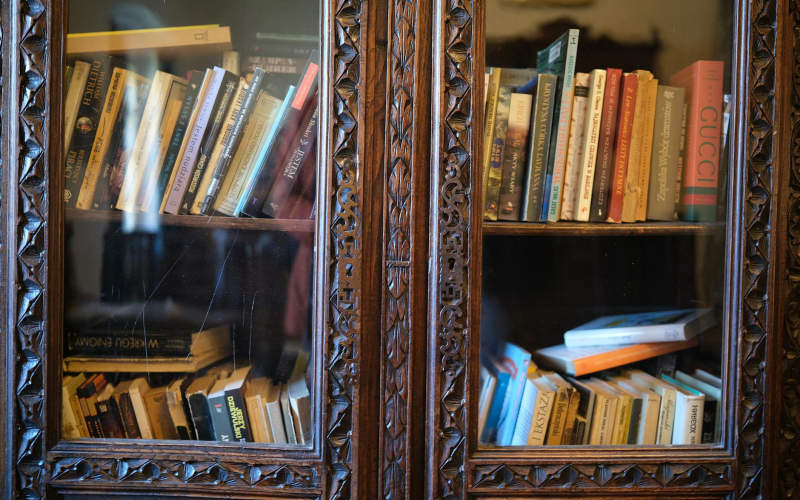

You guys, I have to be honest about something — most bookshelf styling advice out there is TERRIBLE. “Just add some plants and pretty books!” Cool, thanks. Super helpful. What actually ends up happening is you throw stuff on the shelves, step back, and think… why does this look like a storage unit?
I’ve been obsessing over interior styling for over a decade, and bookshelves specifically are where I see people go wrong the most. The good news? There’s a real, repeatable process behind every designer shelf you’ve ever drooled over on Pinterest. And once you learn it, you cannot unsee it.
So here are the 7 steps I use every single time — starting from a completely bare shelf to something that genuinely looks like a professional styled it.
Step 1: Clear It ALL Out First
I mean everything. Every book, every candle, every random souvenir from that 2019 trip to Barcelona. Off the shelf. On the floor.
This step feels counterintuitive but it’s NON-NEGOTIABLE. You cannot style on top of existing chaos and expect a clean result. Designers always start with a blank canvas because it forces you to make intentional decisions instead of just shuffling things around and hoping for the best.
Step 2: Pick Your Color Story Before Touching a Single Object
Here’s where most people skip straight to arranging things — and that’s exactly why their shelves end up looking busy and random.
Before anything goes back up, decide on 2 to 3 colors that will anchor the whole shelf. For me, I personally love a neutral base (creams, warm whites, natural wood tones) with one accent color pulled from the room. say, a dusty terracotta or a deep forest green. Designer Jerlyn Ngo, who styled some of the most-shared interiors on Apartment Therapy in early 2026, talks about this as “pulling color threads” through a space. The shelf should echo what’s already living in your room, not fight it.
Write your 3 colors down. Literally. Keep that list next to you as you work through the next steps.
Step 3: Sort Your Books by Color, Not by Title
Yeah, I know. Your inner English-major is screaming. But trust the process.
Organizing books by color instead of author or subject is the single fastest way to make a shelf look styled rather than just stacked. Pull out books with spines that match your color story. The others? Face them backward, white pages out. for a clean, cohesive filler. This trick alone transformed a shelf in my own home office from cluttered to calm, and it took about 11 minutes.
Group books in stacks of 2 to 4, sometimes vertical, sometimes horizontal. Vary the heights. That variation is what creates visual rhythm.
Step 4: Establish Your Anchor Objects First
Not every object belongs on a bookshelf. Only a few do, and those few need to be SUBSTANTIAL enough to anchor a section of the shelf visually.
We’re talking things like a sculptural vase (even a simple H&M Home ceramic one works), a larger piece of art leaned casually against the back panel, a meaningful object with visual weight. Place your biggest, boldest pieces first, one per shelf section. These are your anchors. Everything else orbits around them.
And please. only one “statement” item per shelf row. One. When everything is competing to be the focal point, nothing actually is.
Step 5: Bring In Height Variation With a Rule of Threes
Designers think in triangles. Honestly, this changed everything for me when I finally understood it.
The rule of threes means grouping objects in odd numbers, 3 items of varying heights create natural visual tension that feels balanced but not boring. A tall candlestick, a mid-height stack of books, a small low bowl. Your eye moves across them and feels satisfied without knowing exactly why.
Apply this across EACH shelf, not just the overall unit. Every row gets its own triangle. Once you start seeing it, you’ll spot it in every beautifully styled shelf photo you’ve ever saved.
Step 6: Layer in Natural Elements and Negative Space
So here’s the thing about greenery and natural textures. they’re not decoration. They’re breathing room.
A small trailing pothos, a dried pampas stem in a narrow vase, a chunk of raw quartz from a local market, these elements soften the hardness of books and ceramics and make the shelf feel lived-in rather than staged. But here’s what nobody talks enough about: NEGATIVE SPACE. Empty space is not empty. It’s intentional pause. Leave at least one full section of your shelf partially open, with just one or two items on it. That restraint is what separates a designer shelf from a cluttered one.
I cannot stress this enough. Resist. The. Urge. To fill every inch.
Step 7: Do a 10-Foot Edit.
Then Remove One More Thing
Step back. Actually walk across the room and look at the whole shelf from at least 10 feet away.
Things that looked fine up close can feel visually noisy from a distance, and that’s the view most people actually experience in your home. What jumps out uncomfortably? What feels heavy on one side? Where does your eye get stuck instead of flowing naturally? Make adjustments from here, not from 6 inches away.
And then. remove one more thing. This is the step I always make my clients do, and they almost always admit afterward it was the right call. Edited is almost always better than full.
What I’d Do If I Were Starting Today
Here’s my honest take that most styling guides skip entirely: the real reason bookshelf styling feels overwhelming is that people treat it like decoration when it’s actually closer to composition. You’re not just placing pretty objects. You’re choreographing where the eye travels.
If I were styling a shelf from scratch today, I’d start with the color story and the anchor objects, then let everything else fill in around those two decisions. That’s the actual designer shortcut, strong foundations, then layers. The rest shakes out naturally once you have those two things locked in. Your shelf doesn’t need to be perfect. But it does need to be intentional. Those are very different things.
FAQ
How many items should go on a styled bookshelf?
Less than you think. A good rule is to use about 60-70% of the available shelf space and leave the rest as negative space. Overcrowding is the most common styling mistake I see.
Do books have to be color-organized to look good?
Nope. but it helps significantly. If color-organizing your books stresses you out, facing them backward (pages out) gives you a clean neutral backdrop that works just as well.
What’s the easiest way to make a bookshelf look more expensive?
Swap out anything plastic for natural materials, ceramic, wood, linen, stone. Even inexpensive items in natural textures read as considered and elevated. That swap alone makes a dramatic difference.
Photo by Roman Biernacki on Pexels

