
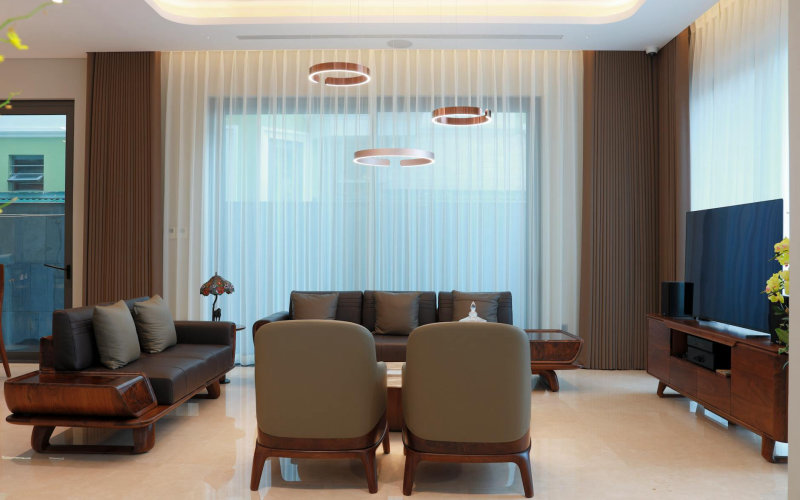

I’ve rearranged my living room eleven times. Not kidding. And every single time, something felt slightly off until I finally understood that furniture arrangement isn’t about taste—it’s about geometry, traffic, and how humans actually move through a space.
Most people buy beautiful furniture and then shove it all against the walls, leaving a dead zone in the middle. Or they cram everything together so tightly that walking through feels like navigating a corn maze. Neither works. And the frustrating part? The fixes are almost embarrassingly obvious once you know what to look for.
These eight rules apply whether you’re working with a 180-square-foot studio or a 600-square-foot open-plan showpiece. They’re not trends. They’re physics, psychology, and a little common sense.
1. Define Your Conversation Zone First
Before you touch a single piece of furniture, figure out where people will actually sit and talk. That’s your anchor. Everything else arranges itself around it.
Interior designer Nate Berkus has been talking about this for years—the idea that a room needs one clear “gravitational center” that pulls people in. For most living rooms, that’s a sofa and two chairs positioned so no seat sits more than 8 feet from another. Push past 8 feet and conversation dies. People stop talking and start shouting.
In a small space, your zone might be a loveseat and one armchair. In a larger room, maybe two full sofas facing each other. The scale shifts. The principle doesn’t.
2. Float Your Furniture Away From the Walls
Stop. Pushing. Everything. Against. The walls.
I know it feels wrong—especially in a small room where you think you need every inch of floor space. But furniture floating even 3-4 inches off the wall creates visual depth, makes the room feel deliberate rather than temporary, and actually makes small rooms read as larger. HGTV’s designers have been hammering this since the early 2000s for good reason.
The sweet spot for most sofas is 12-18 inches off the back wall. Sounds tiny. Walk into a room where it’s done right and you’ll feel the difference immediately, even if you can’t explain why.
3. Anchor Everything to a Rug
Your rug is not decoration. It’s architecture.
A rug defines where your seating group lives. And the most common mistake I see—in friends’ homes, in staging photos, everywhere—is a rug that’s too small. One where only the coffee table sits on it looks like a postage stamp dropped in a football field.
The rule: in a medium room (roughly 12×14 feet), go with at least an 8×10 rug. Larger room? A 9×12 or bigger. All four sofa legs on the rug is ideal. Front legs only works fine too. No legs on at all, though, and your seating group starts to look unmoored—disconnected and strange.
4. Create a Clear Traffic Lane
Worth asking yourself honestly: can you walk from your front door to your kitchen without turning sideways?
Traffic lanes need at least 36 inches of clearance—that’s the standard ADA measurement, and it also just happens to feel comfortable for actual human bodies. Secondary pathways within the room can run a bit narrower, around 24-30 inches. But the main route through? Don’t block it.
So many layout disasters trace back to one misplaced ottoman or an oversized sectional that splits the room in two. You don’t have to sacrifice seating. You just need to map the flow before anything gets placed.
5. Match Your Focal Point to Your Furniture Arrangement
Every room has one. A fireplace. A TV. A big window with a view worth looking at. Your furniture should face it—not awkwardly angle away from it.
In a 2019 survey by the American Society of Interior Designers, nearly 68% of homeowners said their primary living room complaint was that “nothing felt cohesive.” Most of those rooms had furniture pointed toward multiple focal points simultaneously—TV in one corner, fireplace on another wall, everyone slowly wrenching their necks trying to split the difference.
Pick one focal point. Commit. Arrange your seating so everyone in the conversation zone faces it comfortably. If you’ve got both a TV and a fireplace, they need to share a wall or one has to yield.
6. Scale Your Furniture to the Room—Not to Your Wishlist
That massive sectional looked incredible in the showroom. The showroom was 2,000 square feet.
Furniture that’s too large doesn’t just look bad—it makes the space feel smaller and more chaotic than it actually is. Designer Bobby Berk puts it simply: your furniture should occupy roughly two-thirds of the usable floor space, leaving one-third open. In a 12×16 foot room, that’s about 128 square feet of breathing room.
But here’s what people miss about small spaces: one well-scaled sofa paired with two lighter chairs—something with exposed legs, maybe cane or thin metal frames—reads as far more spacious than a loveseat jammed next to a bulky recliner. Visual weight matters just as much as actual dimensions.
7. Balance Visual Weight Around the Room
Symmetry is calming. Complete symmetry is boring. You want something in between.
If your sofa sits on one wall, you don’t want all your other heavy pieces clumped on that same side. Spread the weight around. Tall bookcase on the left? Balance it with something on the right—a gallery wall, a floor lamp, whatever works. Not identical. Just balanced.
Designers call this “asymmetrical balance,” and it’s honestly harder to pull off than simple mirroring. Here’s a shortcut: photograph your room from the doorway and look at it in black and white. If one side of the frame looks dramatically heavier or darker than the other, something needs to shift.
8. Lighting Belongs in the Layout Plan, Not as an Afterthought
Most people figure out lighting after everything’s already placed. That’s completely backwards.
Floor lamps, table lamps, and overhead fixtures all need to work with where your seating landed—not just plugged in wherever an outlet happens to exist. A lamp behind the sofa lights the room. A lamp shoved into a corner because there’s nowhere else to put it does basically nothing useful.
Plan for at least three light sources at varying heights. That comes straight from lighting designer Randall Whitehead, who’s been writing about residential lighting since the 1980s. Overhead-only is harsh. Under-lit corners feel unfinished. Three layers—ambient, task, and accent—makes any size room feel genuinely pulled together.
Bottom Line
Here’s something I haven’t seen spelled out anywhere else: the secret to a living room that actually works isn’t following all eight of these rules perfectly—it’s following them in order. Start with the conversation zone. Then traffic flow. Then the rug. If you try placing the rug before you know where the seating goes, you’ll get it wrong and blame the rug. Sequence matters more than perfection, and most redesigns fail not because of bad taste but because someone started from the wrong end of the problem.
Frequently Asked Questions
How far should a sofa be from the TV?
Ideally between 7 and 10 feet, depending on screen size. A 65-inch TV sits comfortably at about 8-9 feet. Closer than 6 feet and you’re craning your neck; farther than 12 feet and you’re squinting.
Can you put a rug in a small living room?
Yes—and you probably should. The mistake isn’t using a rug in a small room, it’s using one that’s too small. A well-sized rug (at least 5×8 in a tight space) anchors the room and makes it feel more intentional, not more crowded.
Do all living room furniture legs need to be on the rug?
Not necessarily. Front legs on the rug is a widely accepted approach and works well in most rooms. All legs on is ideal if your rug is large enough. No legs on at all looks disconnected—unless you’re deliberately going for a layered, eclectic vibe.
What’s the biggest living room layout mistake people make?
Pushing all the furniture against the walls. It creates an awkward empty center, makes conversation uncomfortable, and—counterintuitively—makes even large rooms feel smaller and less welcoming than they should.
Photo by HONG SON on Pexels

