
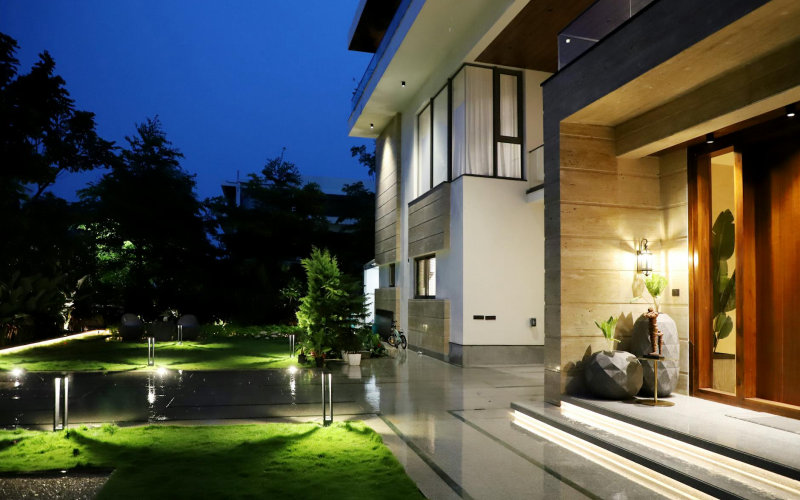

I’ll be honest with you. I dropped roughly $400 on outdoor lighting my first year as a homeowner and got nearly all of it wrong. Too bright in certain spots, pitch black in others, and the whole mess made my front yard look like a used car lot at 2am. Not exactly the warm, welcoming curb appeal I’d pictured in my head.
Most homeowners stumble into the exact same trap. They grab whatever’s cheap at Home Depot, shove it near the front door, and call it a day. But outdoor lighting is genuinely one of those areas where a little strategy pays off enormously—and the fixes are usually far simpler and cheaper than anyone expects.
So here’s what years of trial, error, and genuinely humiliating lighting setups have taught me. Real mistakes. Real fixes. And yes, you can knock most of these out on a Saturday afternoon.
You’re Using Way Too Much Wattage
This is mistake number one. By a wide margin.
Homeowners reach for the brightest bulb on the shelf because brighter feels safer. Completely understandable. But 100-watt-equivalent bulbs aimed at your walkway don’t make your home feel secure—they make it feel like a stadium. Security lighting research from the University of Chicago (2021) actually found that excessively bright residential lighting creates more shadows around entry points, which works directly against you.
For pathway lighting, you want 40-watt equivalent LEDs at most. Accent lighting on trees or architectural features? Twenty to thirty watts is plenty. The goal is layering, not flooding.
Fix this weekend: Swap your brightest fixtures for warm-white LEDs in the 2700K to 3000K range. Maybe $15 at Lowe’s. Ten minutes per fixture.
All Your Lights Are Pointed the Wrong Direction
Here’s something the packaging never tells you. Direction matters more than wattage.
Most people point their path lights straight up, or mount wall fixtures that throw light directly outward—which creates glare at eye level and does almost nothing to illuminate the actual ground you’re walking on. The industry calls this “light trespass,” and it’s precisely why your neighbors sometimes squint when they glance over at your house.
Downlighting beats uplighting for functional outdoor spaces nearly every time. Position fixtures so the beam lands on the ground or surface you actually want lit, not on the faces of anyone walking past. The International Dark-Sky Association has championed this principle for years, and honestly? It just looks better too.
If you’re lighting a tree or garden feature for drama, low-angled uplighting from the base works beautifully. But everything else—point it down.
You’re Ignoring the Front Door Entirely
Your front door is the focal point of the entire exterior. And yet so many people pour all their effort into the driveway or garden beds while leaving the actual entrance dim and kind of depressing.
Think about it from a visitor’s perspective. When someone pulls up to your house at night, where do their eyes go first? They’re looking for the door. They want to feel welcomed. One flickering porch bulb from 2009 isn’t doing that job.
Two flanking wall sconces beside the door—matched in finish to your door hardware—make a striking difference. Zillow’s 2023 home design report noted that homes with well-lit, symmetrical entry lighting photographed better and pulled more online engagement than those without. Not exactly shocking, but worth filing away.
And if you don’t have an overhead fixture above the door, add one. Bronze or matte black options from Kichler or Progress Lighting run $40 to $80 and look genuinely high-end once they’re up.
You Forgot About Layering
Flat lighting is boring lighting. Full stop.
What separates a thoughtfully designed outdoor setup from a forgettable one isn’t the price of the fixtures—it’s whether you’ve got multiple layers of light working at different heights and intensities. Ambient light from overhead. Accent light drawing attention to specific features. Task light exactly where you actually do things (the grill, the front steps, the gate latch).
I see yards constantly that have eight identical path lights marching in a straight row and absolutely nothing else. Everything sits at ankle height, everything is the same brightness, and the whole thing reads as monotonous even when it’s technically illuminated. You’ve got to mix it up.
Think of it this way: your outdoor space at night should feel like a well-staged room, not a runway.
Your Timer or Smart Controls Are Outdated
If your outdoor lights still run on a mechanical timer from 2012, you’re wasting money and probably irritating your neighbors when the lights kick on at 3pm in July.
Smart plugs and switches from brands like Kasa (around $15 per plug) or Lutron Caseta (roughly $50 for a full switch kit) sync your lighting schedule to actual sunset and sunrise times, adjusting automatically as the seasons shift. Some even pair with motion sensors so lights only run when somebody’s actually outside.
The Kasa EP25 smart plug has geofencing built right in—your lights can respond to whether you’re physically home or not. I’ve been running something similar for a couple years now, and it’s noticeably trimmed my outdoor lighting electricity costs.
Set it once. Forget it. And stop burning power to illuminate an empty driveway from 4pm onward.
You’re Using Mismatched Color Temperatures
Walk any suburban street after dark and you’ll spot this immediately. One house glowing warm amber. The neighbor’s place blasting a harsh blue-white that makes everything look like a hospital corridor. Side by side.
Color temperature—measured in Kelvins—matters far more than most people realize. Warm white (2700K–3000K) feels residential and inviting. Cool white (4000K and above) reads as clinical, almost commercial. Unless your home is a sleek modern architectural statement, you almost certainly want warm white across the board.
And please—pick one temperature and commit to it for your entire exterior. Mixing 2700K path lights with 5000K security floods looks genuinely bad, even when each individual fixture seems perfectly fine on its own.
Bottom Line
Here’s my honest takeaway after years of fiddling with this stuff: most outdoor lighting problems aren’t really about the fixtures at all. They’re about homeowners treating outdoor lighting as a security system rather than an extension of the home’s personality. The mental shift that actually fixes everything? Light what you love, not what you fear. Stop trying to banish every shadow, and start thinking about what you want people to notice—what you want them to feel—when they approach your home at night. The decisions get cleaner, the results get dramatically better, and security becomes a natural side effect of good design. It was never supposed to be the whole point.
Frequently Asked Questions
How much should I budget for fixing my outdoor lighting setup?
Most meaningful improvements land between $100 and $300 if you’re doing the work yourself and focusing on bulbs or smart controls. Full fixture replacement for a typical front entry runs $150 to $400 depending on what you choose.
Do I need an electrician for any of this?
For swapping bulbs, adding solar path lights, or plugging in smart plugs—no. For hardwired new fixtures where no wiring currently exists, yes. Don’t touch that yourself unless you genuinely know what you’re doing.
What’s the easiest single fix to make this weekend?
Replace every outdoor bulb with a warm-white 2700K LED. That’s it. Under $30, and it makes a more visible difference than almost anything else you can do in a single afternoon.
Are solar lights ever worth it for the front yard?
For low-traffic spots and decorative accent lighting, sure. For your main entry or anywhere you need reliable, consistent output—no. Solar lights underperform in winter and in shaded yards, and the output rarely cuts it for real task lighting.
Photo by Sharath G. on Pexels

