
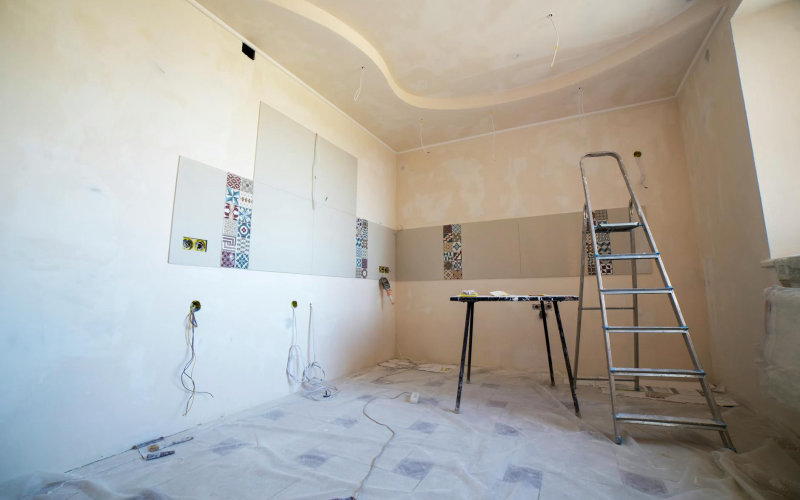

You patched the hole. You painted over it. You stepped back, looked at the wall, and somehow it looks worse than before. More obvious. Like the wall is now actively announcing that something used to live there.
I’ve been there. The first time I patched a drywall hole — a doorknob dent, maybe three inches across, in a rental I was moving out of in 2019 — I was so proud of myself. Bought the little mesh patch kit from Home Depot, slapped on some joint compound, painted it the next morning. The landlord walked in, pointed at it immediately, and charged me $80 for a professional repair. That stung. But honestly? It was the best $80 I ever spent, because watching the guy work taught me more in 20 minutes than any YouTube video had.
These are the five mistakes that kept tripping me up — and that I see come up constantly from readers who write in frustrated after their “quick fix” looks anything but.
Using Too Much Compound in One Pass
This is the big one. The instinct makes total sense: the hole is deep, so fill it deep, right? But joint compound shrinks as it dries. sometimes by 15 to 20 percent of its original volume. If you load it on thick, the surface cracks, sags, or pulls away from the edges, and you end up with something that looks textured in a very bad, unintentional way.
What actually works is thin coats. I mean genuinely thin, almost embarrassingly thin, like you’re skim-coating rather than filling. Three light passes, letting each one dry completely, beats one heavy swipe every single time. And “dry completely” means overnight, not two hours. Rushing this step is how you get a patch that looks fine until you paint it, and then suddenly every imperfection shows up under the new sheen.
Skipping the Primer Before You Paint
So your compound is dry, it’s sanded smooth, and you’re tempted to just roll your wall color right over it. Don’t. Joint compound is extremely porous and thirsty. it will drink your paint differently than the surrounding drywall does, which creates what’s called “flashing.” That’s when your repaired spot shows up as a dull, flat circle even after multiple coats of your wall color.
A coat of drywall primer (or a PVA primer, which runs about $12 at most hardware stores) seals the compound first. It takes maybe 10 minutes to apply and an hour to dry. And it’s genuinely the difference between a patch you can see from across the room and one that disappears. I started keeping a small can of Zinsser’s Bulls Eye 1-2-3 under my sink specifically for this. Total huge deal for patches under six inches.
Sanding Too Aggressively (Or Not Enough)
Both extremes ruin the finish. Not enough sanding leaves ridges and buildup at the edges where the compound meets bare drywall, you can feel it when you run your hand across it, and a raking light (meaning a lamp held close to the wall at a sharp angle) will expose every bit of it. Sand too hard, though, and you scuff through the compound into the drywall paper underneath, which raises a fuzzy, rough texture that paint won’t hide.
The sweet spot is 120-grit sandpaper, used with a light, circular motion. Feather the edges out about four to six inches from the patch so the transition is gradual. Then do a final pass with 150-grit to smooth everything out. Wipe it down with a barely damp cloth after. And check your work with that raking light trick before you even think about reaching for the primer.
Using the Wrong Patch Method for the Hole Size
Not all holes are the same. A nail hole? Toothpaste or a tiny dab of compound, done. But a lot of beginners use that same minimal approach on holes that are two, three, even four inches across. and it fails, every time, because there’s nothing structural supporting the compound.
Here’s a rough guide that’s served me well. Holes under half an inch: just compound, no backing needed. Half an inch to about three inches: a self-adhesive mesh patch works well, but press it firmly before you apply compound, any air bubbles and it’ll lift later.
Anything larger than three inches really wants a California patch (where you cut a clean square, use the drywall face paper as a hinge) or a proper backing board screwed in through the existing drywall. Skipping this step and just globbing compound over a larger hole gives you a repair that feels hollow when you tap it and cracks within a year.
Ignoring Wall Texture Completely
This is the mistake that haunts people even when they do everything else right. You get a smooth, beautifully primed, freshly painted patch. and it stands out like a polished stone in a gravel driveway because the rest of your wall has texture and your patch is flat as glass.
Matching texture is genuinely the trickiest part, and most beginner guides just… skip it. But it’s not as hard as it sounds. Orange peel texture (the most common in homes built after about 1990) can be recreated pretty convincingly with a can of spray texture from Rust-Oleum or Homax, held about 18 inches from the wall, in short bursts.
Practice on a scrap piece of cardboard first until you match the pattern. Knockdown texture, the one that looks like flattened, irregular shapes. takes a little more patience; you lightly dab compound with a sponge or crumpled plastic bag, let it get tacky, then very lightly drag a drywall knife across it. Not perfect the first time.
But much better than leaving it smooth.
What I’d Actually Do If I Were Starting Over
Honestly? I’d buy a five-in-one painter’s tool, a small tub of lightweight all-purpose compound (not the “fast-drying” stuff, which is harder to sand), and a can of PVA primer before I touched a single hole. The total outlay is maybe $25. And I’d stop trying to finish the job in one afternoon.
The patches that look invisible share one trait: patience. Multiple thin coats. Full drying time. The raking light check between every stage. It’s not glamorous advice. But it’s the real reason the $80 guy’s repair vanished into the wall while mine announced itself like a billboard.
Your walls can look right again. Just stop rushing the part where you wait.
Photo by Valentin Ivantsov on Pexels

