
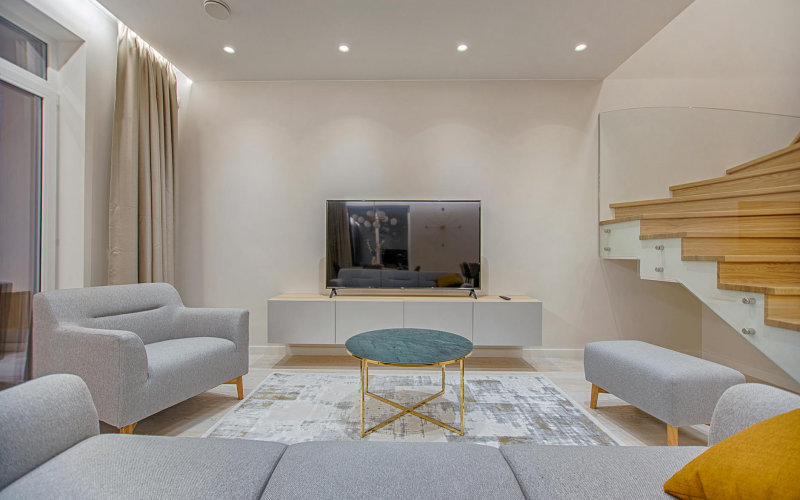

My living room used to look like a hospital waiting room at night.
One overhead light. Bright. Flat. Completely soulless. I’d bought decent furniture, hung art I genuinely cared about, and the whole thing still felt off after 6pm. It took me way too long to realize the problem wasn’t the sofa or the paint color. It was the light—or more accurately, the total lack of any layering whatsoever.
Here’s the thing: most homes are wired for convenience, not livability. A single ceiling fixture made sense to whoever built your place. But for actually existing in a room—watching movies, having friends over, reading, just unwinding—you need multiple light sources at different heights doing different jobs. And you absolutely don’t need to hire anyone to get there.
Understanding What “Lighting Layers” Actually Means
Interior designers break lighting into three categories, and once you know them, you’ll notice them everywhere.
Ambient lighting is your base layer—general illumination that fills in where daylight leaves off. Task lighting is focused and functional (reading lamps, desk lights, that sort of thing). Accent lighting is purely atmospheric, meant to highlight specific objects or manufacture mood. Most living rooms only have ambient. That’s the problem, full stop.
A properly layered room has all three working together. You can shift between combinations depending on what you’re doing. Movie night looks nothing like a dinner party, even in the exact same room. That flexibility is what you’re actually building toward.
Start With Your Overhead Light (And Fix It First)
Whatever ceiling fixture you’re working with, it’s probably doing too much work—and doing it badly.
The single fastest upgrade you can make costs about $12. Swap your current bulbs for warm-toned LEDs in the 2700K range. Not 3000K. Not daylight. 2700K specifically. That small number makes a surprisingly large visual difference. I swapped mine back in 2021 and honestly couldn’t believe the room felt roughly 40% more welcoming before I’d touched a single piece of furniture.
But here’s what I really want you to do with that overhead: put it on a dimmer. Lutron makes a plug-in lamp dimmer for under $20 that requires zero wiring. If your ceiling light runs through a switched outlet (which plenty of floor lamps do too), you can control it that way. Otherwise, something like a Philips Hue White—around $15 a bulb—lets you dim straight from your phone, immediately.
Drop that overhead to 30–40% brightness after 7pm. Just try it once. The room genuinely transforms.
Add Floor Lamps Strategically, Not Randomly
Most people shove a floor lamp in the corner because that’s where it fits. That’s completely backwards.
You want floor lamps close to seating areas and—this part actually matters—aimed upward or toward walls rather than straight down onto a table. An uplight bouncing off a white or light-colored wall creates this remarkably warm, diffused glow that makes a room read as bigger than it is. IKEA’s HEKTAR floor lamp has been around since roughly 2015 and still works brilliantly for this at $50.
Two floor lamps on opposite sides of the room create balance and instantly kill that flat, single-source look. If your room runs bigger than 200 square feet, you probably need three.
Height matters too. Lamps with shades sitting around 60 inches from the floor tend to scatter light most effectively across a seated space—something about that eye-level spread just works.
Bring In Table Lamps for the Middle Layer
Table lamps are doing two things at once—they’re providing soft task light for whoever’s sitting nearby, and they’re building visual interest at eye level when you’re actually seated in the room.
This is the layer most people skip entirely. Don’t.
A pair of matching lamps flanking a sofa or bracketing a media console creates that pulled-together quality you notice in every well-designed room you’ve ever secretly envied. Shade material matters more than most people expect—a white linen shade throws warm light outward in a wide arc, while a dark opaque shade pushes light downward more dramatically. Pick based on what that particular spot actually needs.
For table lamp bulbs, I almost always land on something in the 40–60 watt equivalent range (LED, obviously). Go brighter and the lamp starts competing with the room instead of contributing to it.
Use Accent Lighting to Make the Room Feel Curated
This is the layer that separates a nice room from a genuinely great one. We’re talking LED strip lights behind a TV or bookshelf, picture lights over art, candles, battery-operated puck lights inside display cabinets.
Govee makes LED strip lights for around $25 per 16-foot set, and you can get them behind a TV console or under a floating shelf in maybe 15 minutes. Set them to a warm amber—not the rainbow party mode, unless that’s genuinely your thing—and they add real depth to the back half of the room. It’s one of those changes that looks like you spent a lot more than you did.
Battery-powered picture lights (Cordless Lighting Direct carries solid ones in the $30–50 range) mean you can actually highlight the art you paid for without running a single wire. Most guests won’t consciously register it, but they’ll feel it.
Use Smart Plugs and Bulbs to Create “Scenes”
This is where it all clicks.
Once you’ve got multiple light sources in place, smart plugs let you group them into scenes. TP-Link Kasa makes reliable ones for around $15 each. A “movie” scene might run just your accent lights and one dimmed floor lamp. An “entertaining” scene brings everything up to medium. A “reading” scene cranks the lamp nearest your chair while keeping everything else quiet.
You don’t need a full smart home ecosystem for this. Even connecting two lamps to voice-controlled plugs changes how you actually inhabit the room. It stops being about fiddling with individual switches and starts being about setting the whole atmosphere at once—which sounds fancier than it is, but the difference is real.
Bottom Line
Here’s something I’ve genuinely never seen anyone say outright about living room lighting: the goal isn’t to evenly illuminate your room. It’s to deliberately leave parts of it in shadow.
Every bar, restaurant, or hotel lobby you’ve ever found cozy had corners you couldn’t quite see into. That contrast—bright near seating, softer as you move toward the edges—is what our brains read as “warm” and “inviting.” When everything’s lit equally, the eye has nowhere to settle and the room just feels like a showroom floor.
So when you’re placing your lamps, don’t try to chase down every dark spot. Point your light at the things worth seeing—your seating area, your books, your art—and let the edges go soft. That’s not an unfinished room. That’s exactly the point.
Frequently Asked Questions
How many light sources should a living room have?
Most interior designers recommend at least 5–7 individual sources for a medium-sized living room (around 250 square feet). That sounds like a lot until you start counting candles, accent strips, and table lamps—it adds up faster than you’d think.
Can I really layer lighting without touching any electrical wiring?
Completely. Plug-in floor lamps, smart bulbs, battery-operated picture lights, LED strips, and smart plugs cover every layer without a single wire touched. Everything in this article is plug-and-play.
What color temperature is best for living room ambiance?
Stick to 2700K for warm, cozy light. 3000K works if you want things slightly crisper, but don’t go higher than that in a room you actually want to relax in. Daylight bulbs (5000K and up) belong in garages and kitchens.
Do I need all three lighting layers every night?
Nope. The whole point of building layers is flexibility. Some nights you’ll run just accent lighting and one lamp. Others you’ll fire up everything. Having the option is what counts—you can’t create atmosphere with a light source you don’t own.
Photo by Viaceslav Kat on Pexels

