

Seven straight summers I pulled weeds. Same beds, same weeds, same wrecked back every single weekend. I was losing and I knew it. My neighbor, though — her garden looked like something out of a magazine, and I genuinely never once caught her on her knees in the dirt. No fancy sprays. No elaborate mulching ritual. She’d just planted the right ground covers and stepped back.
Ground cover plants that suppress weeds do something herbicides never quite pull off permanently. They move in, block the light, and physically elbow out anything trying to grow underneath. Biology doing the heavy lifting instead of you.
So here are seven that actually deliver on that promise. Not “help a little” — genuinely choke weeds out over time.
1. Creeping Thyme (Thymus serpyllum)
This one’s earned a permanent spot in my front beds. Creeping thyme tops out around 3 inches, spreads aggressively in every direction, and throws up tiny purple flowers that bees absolutely lose their minds over in June.
But here’s what most people miss — it tolerates foot traffic. Plant it between stepping stones and it’ll survive being walked on regularly, which almost nothing else will. Fills cracks, corners, and awkward slopes with equal enthusiasm.
One plant can spread 12–18 inches wide in its second year. Space them 12 inches apart and within two growing seasons you’ve got a solid mat weeds simply can’t push through. Full sun preferred. Poor, dry soil? Even better, honestly.
2. Creeping Jenny (Lysimachia nummularia)
Don’t let the delicate look fool you. Creeping Jenny is quietly one of the most territorial plants you can drop into a shady or semi-shady bed, spreading with the kind of single-minded determination usually reserved for dandelions.
The golden variety (‘Aurea’) practically glows in low-light spots where most plants just sulk. It hugs the ground at about 2 inches and runners can push 2 feet per season in moist soil. That’s fast enough to make a real dent in weed populations within a single summer.
One honest caveat: in wet climates it can turn invasive near natural water features. Keep it contained to your beds and you’re fine.
3. Pachysandra (Pachysandra terminalis)
Ask any landscaper what they use under trees where nothing else survives, and pachysandra comes up every time. There’s a reason commercial properties across the northeastern US lean on this plant almost exclusively for shaded problem areas.
The first year it grows slowly. Painfully slowly, if I’m being straight with you. But by year three you’ve got a dense, 8-inch evergreen carpet that blocks light so effectively almost nothing gets through. The University of Connecticut Extension program found that established pachysandra beds reduced weed emergence by over 80% compared to bare mulched soil.
Plant it 6–12 inches apart in full to partial shade. It won’t do much in full sun, but under those old oaks and maples where you’ve already given up? That’s exactly where it thrives.
4. Vinca Minor (Periwinkle)
Vinca minor is the workhorse nobody talks about enough. It’s been carpeting American gardens since colonial times — there are actual records of it growing in Virginia gardens in the 1700s — and it’s still one of the most dependable weed-smotherers you can plant.
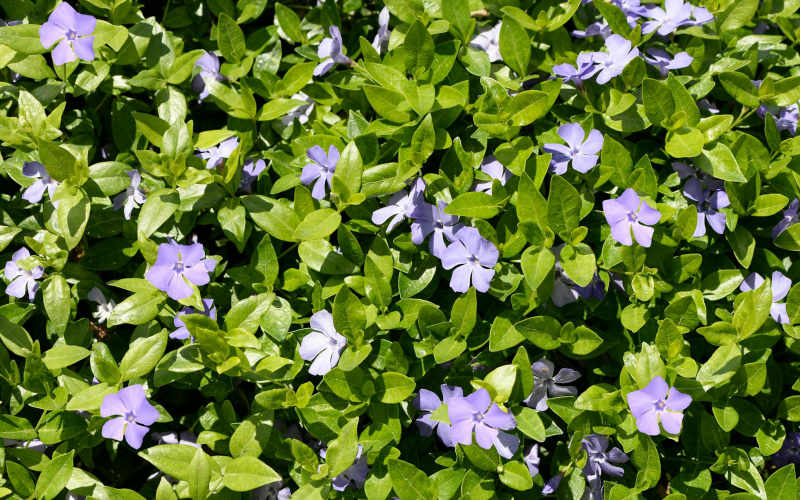
It trails along at about 6 inches tall, roots wherever its stems brush the soil, and puts out those familiar blue-purple flowers each spring. In deep shade under dense trees it outperforms nearly everything else on this list.
Fair warning, though. Vinca is considered invasive in parts of the Midwest and Pacific Northwest, so check your local extension office before planting. In a controlled garden bed it’s manageable. Let it wander into a woodland edge and things can go sideways fast.
5. Sedum (Stonecrop Varieties)
Rocky banks, south-facing slopes, that miserable strip between the driveway and the fence — if you’ve basically written off a sunny, bone-dry spot, low-growing sedums are what you’ve been looking for.
Sedum spurium ‘Dragon’s Blood’ is my personal pick. Turns burgundy-red in fall, flowers pink in summer, spreads 18–24 inches while staying under 4 inches tall. Drought conditions that would finish off most plants? Sedum just shrugs and keeps going.
And because it thrives in poor, fast-draining soil that weeds find hostile anyway, it’s running a double suppression strategy — competing physically AND claiming terrain that favors it over most weed species. Smart plant.
6. Ajuga (Bugleweed)
Ajuga reptans is one of those plants garden snobs inexplicably overlook, which I’ve never understood. Fast, tough, handles both sun and shade, and those dark bronze or purple leaves genuinely look good through most of the year.
It throws up vertical blue flower spikes in May that pollinators love, then settles into a tight 3–4 inch mat for the rest of the season. Spreads by runners roughly 12 inches annually. Plant a flat of 18 plants in a 4×6 foot bed and you’ll have full coverage by the following spring.
Its one real enemy is crown rot from poor drainage. Give it anything that drains reasonably well and it’ll be fine. It’s survived two ice storms and a record dry summer in my zone 6b garden without a single complaint.
7. Sweet Woodruff (Galium odoratum)
Shade gardens can feel like a weed battle you’re destined to lose. Grass creeps in from the edges, random seedlings materialize out of nowhere, and nothing you plant ever seems thick enough to stop any of it. Sweet woodruff fixes this problem with surprising elegance.
It looks delicate but spreads with real aggression in full to partial shade, reaching 8–12 inches tall with small white flowers in spring. Crush the leaves and they smell faintly of vanilla — pleasant bonus. Spreads 12–18 inches per season in decent conditions.
And because it goes dormant in winter and comes back reliably in spring (even in zone 5), it gives weed seeds almost no window to establish before the canopy closes back in.
Bottom Line
Here’s something the garden content world rarely says plainly: the real power of ground cover plants that suppress weeds isn’t their spread rate or their density. It’s that they exploit the exact same biological principle weeds use — opportunistic colonization — and turn it back on them. You’re essentially fighting weeds with a domesticated weed. The winner in any garden isn’t the most beautiful plant. It’s the most determined one. So stop defending bare soil between your ornamentals and start asking which aggressive, low-growing plant actually wants that spot. Give it the spot. Then get out of the way.
Frequently Asked Questions
How long before ground cover plants actually suppress weeds effectively?
Most ground covers need 2–3 growing seasons to hit full coverage density. Year one, you’ll still pull some weeds. Year two, noticeably fewer. By year three with established plants, you’re mostly hands-off.
Do I need to use mulch while the ground cover is establishing?
Yes, and this part matters. Apply 2–3 inches of mulch between new plants during years one and two. It bridges the gap while your coverage fills in, and it won’t hurt the ground covers themselves.
Can ground cover plants work on slopes or hillsides?
Absolutely — several of these are actually better on slopes than flat ground. Creeping thyme, sedum, and ajuga all handle slopes well and control erosion at the same time, which is a bonus problem quietly solved.
Will these plants spread into my lawn or other garden beds?
Some can, particularly vinca and creeping Jenny. Metal landscape edging or a cleanly mown border keeps them in check. It’s a minor task compared to weeding every single week.
Photo by Elena Umyskova on Pexels

