
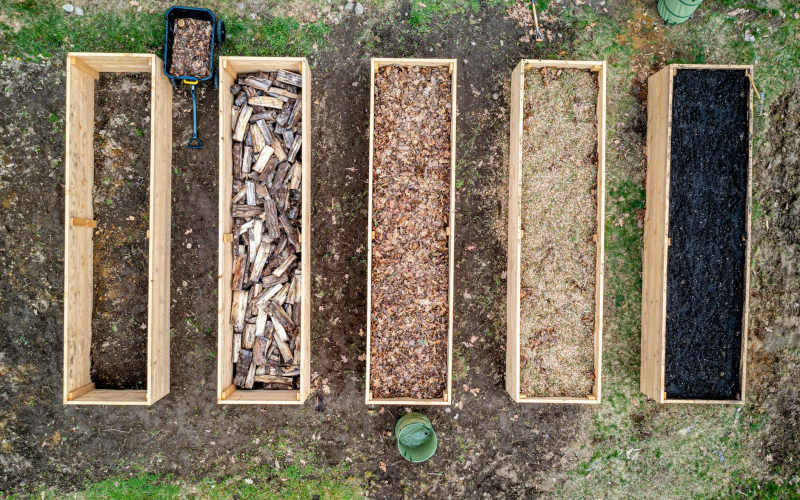

I killed three tomato plants before I finally admitted my yard’s soil was the problem. Dense, compacted clay that pooled water after every rain. My neighbor had a raised bed absolutely overflowing with peppers and zucchini while mine looked like a crime scene. So that fall, I built my first raised bed out of cheap lumber from the home improvement store, spent maybe $40, and it completely changed how I garden. That was 2019. I now have four of them.
If you’ve been putting this off because it sounds complicated or expensive—stop. It’s genuinely one of the most beginner-friendly projects you can tackle. A free Saturday morning, some basic tools, and you’re done by lunch.
Here’s exactly how to do it.
What Kind of Lumber Should You Buy?
This is the question everybody gets hung up on. It doesn’t have to be complicated.
The cheapest option is standard pine or spruce construction lumber—the kind stocked in literally every hardware store. An 8-foot 2×10 board typically runs $8 to $12 depending on your region and what lumber prices are doing that month. For a standard 4×8 foot bed, you need four of those boards (two full-length, two cut to 4 feet), which puts your total lumber cost somewhere around $35 to $50.
Cedar is the upgrade. It resists rot naturally, lasts 10 to 15 years untreated, and smells fantastic—but it runs roughly 3x the price of pine. If budget’s tight, just go with pine. Untreated pine in a garden bed holds up 5 to 7 years before it starts breaking down, and that’s a perfectly decent run.
One thing to avoid: pressure-treated lumber older than roughly 2003. Pre-2004 stuff used arsenic compounds (CCA-treated) that can genuinely leach into soil and mess with your vegetables. Modern pressure-treated lumber uses copper-based preservatives (ACQ or CA-B) and the EPA considers it safe, but a lot of gardeners—myself included—still skip it just to be safe. No reason to introduce unknowns near your food.
Tools and Materials You’ll Need
Nothing exotic here.
Lumber: Four 2x10x8 boards (or 2×12 if you want deeper soil—highly recommended for root vegetables)
Hardware: 3-inch exterior wood screws, about 16 of them
Tools: Circular saw or handsaw, drill with a screwdriver bit, measuring tape, speed square, and a level
Optional but helpful: Landscape fabric, wood stakes or corner brackets for extra strength
Total budget including screws and hardware: under $60 for most people. Under $80 if you go cedar.
How to Cut and Assemble the Frame
Measure twice, cut once. You’ve heard it. It still applies.
For a classic 4×8 foot bed, your two long boards stay at 8 feet. Cut your remaining two boards to 45 inches each—not 4 feet even. The long boards overlap the ends, eating up 3 inches of total width on each side when you’re working with standard 1.5-inch thick dimensional lumber. Skip that calculation and your corners won’t sit flush.
Lay your first long board flat. Butt one of the short boards against its end, perpendicular. Drive two 3-inch screws through the long board into the end grain of the short board. Repeat at the other end. Attach your second long board the same way. You’ve got a rectangle. Check it with a speed square to confirm your corners are actually 90 degrees—if they’re off even a little, your bed will look crooked forever and it’ll bug you every time you walk past it.
Building a taller bed? Stack a second layer of boards on top. Twelve inches of depth is ideal for most vegetables. Stagger the corners on the second course so the seams don’t line up, exactly like bricklaying. That alone adds serious structural strength.
Choosing the Right Location
Before you drop your frame anywhere, think hard about sun exposure. Most vegetables need 6 to 8 full hours of direct sunlight daily. That’s not negotiable. Put the bed in the wrong spot and you’ll struggle no matter how perfect your soil is.
Think about access too. A 4-foot-wide bed is the standard recommendation because you can reach the center from either side without stepping in and compacting anything. Don’t build wider than 4 feet unless you’ve got longer arms than me.
And keep it close to a water source. Raised beds dry out faster than in-ground planting—especially in summer heat—so you’ll water more often than you expect. Hauling a hose 50 feet gets old by mid-July.
Setting Up the Bed and Preparing the Ground
Once your frame is built, place it and use a level to confirm it’s sitting flat. If your yard slopes at all, dig down slightly on the high side rather than propping up the low side—you want solid ground contact all the way around.
Line the bottom? Landscape fabric or cardboard both suppress weeds pushing up from below. I prefer cardboard. It breaks down over time and actually feeds worms. Wet it down after you lay it and it conforms nicely to the shape of the bed.
And if you’re placing the bed on grass, you don’t need to remove the lawn first. The cardboard or fabric kills it off within a few weeks. Saves you a lot of unnecessary digging.
Filling Your Raised Bed With the Right Soil Mix
Don’t fill a raised bed with regular topsoil from your yard. It compacts, drains poorly, and your plants will hate it.
The classic mix that serious growers swear by is called “Mel’s Mix,” popularized by Mel Bartholomew in his 1981 book Square Foot Gardening. One-third compost, one-third peat moss or coconut coir, one-third coarse vermiculite. Light, fluffy, drains beautifully. It’s the gold standard for a reason.
For a 4×8 bed at 10 inches deep, you need roughly 26 cubic feet of material. That sounds like a lot. It is. Budget another $50 to $100 for fill, depending on whether you buy in bulk or in bags.
Most garden centers sell pre-mixed “raised bed soil” in bulk by the cubic yard—way cheaper per volume than bagged product. A cubic yard is 27 cubic feet and runs $30 to $60 at most places, sometimes with delivery if you buy enough.
Finishing Touches Before You Plant
Drive 12-inch wooden stakes or metal fence posts into the ground inside each corner, tight against the frame. This keeps the walls from bowing outward as soil expands and contracts with moisture and rain. Small step, big payoff over time.
Want your lumber to last longer? A coat of raw linseed oil on the outside faces adds years of life without introducing anything harmful near your food. Do it before you fill the bed. One coat is enough.
Bottom Line
Here’s something nobody tells you upfront: the bed itself is almost irrelevant to your gardening success. The real value isn’t the structure—it’s that building one forces you to start fresh with known-quality soil in a defined, manageable space. After 12 years of gardening, I’m convinced most beginner failures aren’t about skill or effort. They’re about fighting bad native soil with no clear way to fix it. A raised bed removes that variable entirely. You’re not trying to rehabilitate ground that took decades to compact. You’re starting from scratch on your own terms. That mental shift alone is worth every penny of the $60 you’ll spend on lumber.
Frequently Asked Questions
How long does it take to build a raised garden bed?
Most people finish the build in 3 to 4 hours, including cutting, assembly, and placement. Filling with soil takes another hour or two. Realistically, a relaxed Saturday morning handles the whole thing.
Can I use pallets instead of buying new lumber?
You can, but be careful. Pallets marked “HT” (heat treated) are safe. Ones marked “MB” were treated with methyl bromide—a fumigant you absolutely don’t want near food crops. Many pallets carry no marking at all, which means unknown history. For a food garden, new lumber is the safer call.
How deep should a raised garden bed be?
Ten to 12 inches handles most vegetables well. Root crops like carrots and parsnips want at least 18 inches. Shallow-rooted herbs and greens can get by with 6. When in doubt, go deeper—you’ll never regret extra root space.
Do I need to use treated lumber to prevent rot?
No. Untreated pine or spruce holds up 5 to 7 years in most climates. Cedar or redwood stretches that to 10 to 15 years with zero chemical treatment. The bed will eventually break down, but you’ll get many good growing seasons out of it long before that happens.
Photo by Skyler Ewing on Pexels

