

You know that feeling when you drive past a house at night and just stop? Not because it’s massive or architecturally interesting, but because the lighting makes it look like something pulled straight from an Architectural Digest spread? I’ve spent years fixating on why some homes look like a million bucks after dark while the house next door resembles an unlit parking structure.
Here’s what nobody actually tells you: the gap usually costs less than $500 total. Sometimes way less. It’s not about the house itself — it’s about how light hits it, where shadows land, and whether your entry says “someone lives here” or “someone genuinely cares about living here.”
I’ve tested a lot of these ideas myself, watched neighbors overhaul their curb appeal practically overnight, and dug through enough exterior projects to know what actually moves the needle. So here are nine lighting approaches that make a real difference.
1. Uplight Your Facade With Wall Washers
Wall washing is probably the single most neglected trick in residential exterior lighting. You place low-profile fixtures at the base of your home’s facade, angled upward, so light “washes” across the siding or brick. The result is striking — especially on textured materials like stone or board-and-batten.
Aim for fixtures with a beam spread around 60 degrees for softer, more even coverage. LED wall washers from brands like Litom or LEONLITE run $25–$60 per unit. Space them roughly every 6–8 feet along the base to avoid hot spots.
2. Frame Your Front Door Like It Deserves Attention
Your front entry is the face of your home. Literally. And most people slap a single builder-grade porch light up there and call it done. Don’t.
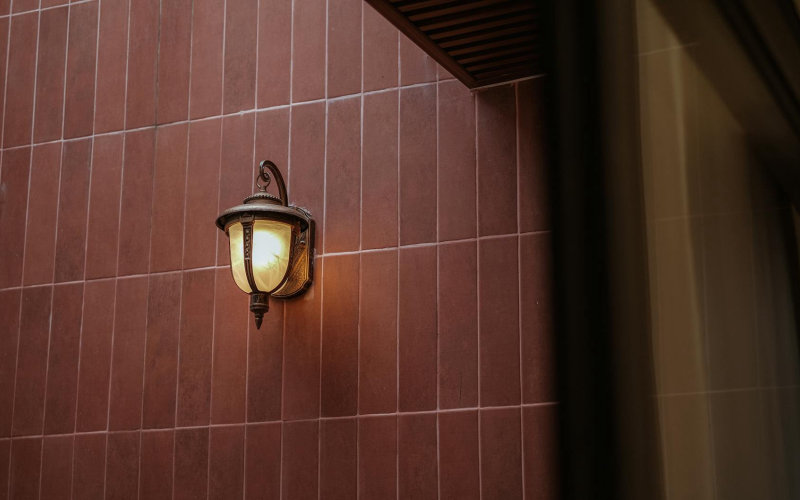
Flanking the door with two matching lantern-style sconces — mounted at about 66 inches from ground to fixture center — creates instant symmetry and visual weight. Go one size bigger than you think you need. A fixture that looks perfectly proportioned at the hardware store will look like a postage stamp once it’s on your exterior wall. (I learned this the hard way after buying sconces that resembled earrings on a billboard.) Brushed brass and matte black both photograph beautifully and tend to hold up well across most climates.
3. Add Path Lights That Actually Match Your Style
Path lighting gets butchered constantly. People buy mismatched solar stakes from three different clearance bins and line their walkway like a runway at a regional airport.
Buy a set. One set. Ideally 6–10 matching fixtures in a single finish — brass, black, or bronze. Space them 8–10 feet apart (not 3 feet — you want rhythm, not a corridor). Brands like Hampton Bay and Kichler offer sets under $150 that look considerably more expensive than they are. The real secret here is restraint. Less genuinely is more.
4. Try Grazing Light on Textured Surfaces
This one’s different from wall washing. Grazing places the light source very close to the wall surface — 6 to 12 inches away — so the beam skims across it at a sharp angle. Every bump, groove, and texture suddenly pops.
Got a stone chimney? Brick accent wall? Board and batten siding? Grazing makes those surfaces look almost three-dimensional at night. It’s a technique used heavily in commercial and hospitality lighting that barely anyone thinks to apply to houses. And it costs almost nothing extra if you’re already buying uplights.
5. Install Soffit Lighting for a Clean, Elevated Look
Recessed soffit lights — those small downlights tucked under your eaves — are what separate “nice house” from “luxury home” in nighttime photography. They cast pools of light on your porch, steps, and landscaping beds without any visible hardware cluttering the facade.
Yes, this one requires some electrical work unless you go with surface-mount options. But a licensed electrician can typically install four to six soffit cans in half a day. In 2023, average electrician rates in the US ran $50–$100 per hour depending on region, putting the total project somewhere between $300–$600 installed. Worth every cent for how clean the result looks.
6. Use Moonlighting in Your Trees
Moonlighting means mounting fixtures high in your trees — sometimes 20 or 30 feet up — and letting light filter down through the branches onto the ground below. It mimics a full moon hitting your landscape. Genuinely beautiful. And baffling how few people bother with it.
You need fixtures rated for tree mounting (look for non-damaging straps and weatherproof ratings of IP65 or higher). The diffused, dappled effect on your lawn and facade is softer than anything a ground-mounted fixture can produce. It also makes your landscaping look intentional and layered — which reads as expensive even from the street.
7. Light Your Garage Doors (Seriously)
On most homes, the garage takes up 30–40% of the visible facade. And most people completely ignore it from a lighting standpoint. That’s a massive missed opportunity.
Adding two pendant lights or carriage-style sconces flanking the garage doors — one on each side — ties the whole facade together. Match the finish to your entry sconces. That continuity alone makes your home look more considered and polished. Budget around $80–$200 for a decent pair. The visual return is almost absurd compared to the cost.
8. Try Colored Uplighting for Seasonality
Okay, hear me out. I’m not talking about the Halloween orange-and-purple situation. I mean subtle warm amber or soft green uplights in your landscape beds that shift slightly with the seasons. Deep amber for fall. Cooler white-green for spring.
Smart outdoor bulbs like the LIFX Outdoor or Philips Hue Lily cost more upfront ($50–$150 per fixture) but let you dial in color temperature and schedule everything from your phone. Even just toggling between 2700K (warm) in winter and 3000K (neutral) in summer makes your home look dynamically tended rather than static and forgotten.
9. Define Your Driveway With Edge Lighting
The driveway approach sets up the entire first impression. Bollard lights — those short, post-style fixtures — placed at the driveway entrance and spaced every 15–20 feet along the edges create a genuine sense of arrival.
You don’t need them the full length for a standard residential driveway. Just the entry and maybe one or two midpoints. Solar bollards have come a long way since around 2020 — brands like Gama Sonic make units that actually stay lit reliably through a full night. A set of four runs roughly $120–$180. Simple install. Surprisingly big visual payoff.
Bottom Line
Here’s what I think most lighting guides miss entirely: it’s not about brightness. Most people’s first instinct is more light, brighter bulbs, wider coverage. But the homes that look genuinely expensive after dark are the ones where darkness is used deliberately. Shadows matter as much as the lit areas. The goal isn’t to flood your facade — it’s to sculpt it. Pick two or three of these ideas, execute them with matching finishes and consistent color temperature (stick to 2700K–3000K for warmth), and you’ll accomplish more through restraint than most people do spending three times the money chasing brighter.
Frequently Asked Questions
How many lumens do outdoor wall sconces need?
For decorative entry sconces, aim for 400–800 lumens. You want enough light to feel functional and visible without obliterating the warmth. Accent lights like path fixtures or bollards can go lower — even 100–200 lumens works well when you have multiples spread across the space.
What’s the best color temperature for outdoor exterior lighting ideas for home facades?
Stick to 2700K–3000K. That warm white range reads as inviting and refined. Anything above 4000K (cool white or daylight) tends to feel clinical and harsh on residential exteriors, no matter how well-made the fixture itself is.
Do solar lights actually work well for facade lighting?
For path lights and bollards — yes, dramatically better than even five years ago. But for wall sconces, uplights, and anything requiring consistent brightness and directionality, hardwired or low-voltage wired systems are still considerably more reliable. Solar is great where it’s great. Know the difference.
Should all my exterior light fixtures match?
They don’t need to be identical, but they should share a finish and a visual sensibility. Mixing matte black sconces with oil-rubbed bronze path lights and brushed nickel bollards just reads as chaotic. Pick a finish family and stay in it across the whole facade.
Photo by Pew Nguyen on Pexels

