
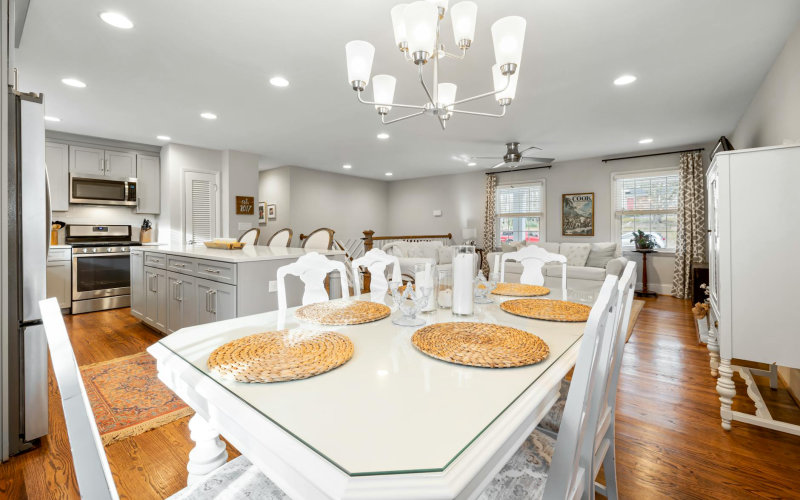

Hey Posse! It’s Alex — and today we need to talk about something I’ve been wanting to say out loud for YEARS.
The interior design industry has been lying to your face about open floor plans. Not in a sneaky, sinister way — but in that glossy, staged, Pinterest-perfect way that makes you feel like a closed wall is basically a crime against humanity. And honestly? I’m done watching people blow their entire renovation budgets chasing a layout that might actually make their lives worse.
So let’s bust some of these myths wide open — because you deserve to know what’s ACTUALLY going on before you pick up that sledgehammer.
“Open Floor Plans Make Your Home Feel Bigger” — Not Always
Okay, here’s the thing. A completely open floor plan CAN create the illusion of space. But it can also make a small home feel like one giant, undifferentiated blob.
I renovated my own place back in 2023 and knocked down what I thought was a pointless wall between my kitchen and living room. Six months later? I was living in what felt like one enormous messy room I could never fully escape. The “spacious” feeling people rave about depends almost entirely on ceiling height, natural light, and furniture scale. NOT just the absence of walls.
Design consultant Maria Killam (look her up, she’s been calling this out since the early 2010s) has argued for years that poorly proportioned open plans actually feel more cramped because your eye has nowhere to rest. And she’s RIGHT.
“Everyone Wants Open Floor Plans”.
The Data Says Otherwise
The design media has been pushing open-plan living as the universal dream since roughly 2009. But buyer preferences have genuinely shifted.
A 2025 survey from the National Association of Home Builders found that 61% of new homebuyers actually said they WANT at least one separated, enclosed room on the main floor, up from 43% just five years earlier. That’s not a blip. That’s a trend.
And honestly, if you’ve worked from home for any stretch of time (which, most of us have), you already know why. Sound travels. Smells travel. Chaos travels. The open floor plan that looks stunning in a Restoration Hardware catalog is the same floor plan that has you hearing your partner’s 9am Zoom call while you’re trying to write, cook, AND watch something all in the same 600 square feet.
“Knocking Down Walls Is Always a Smart Investment”.
Nope
This one frustrates me the MOST because it’s framed as obvious common sense.
Real estate agents love to say “open it up and the value goes up.” But that’s not automatically true, and in 2026, with remote work now a permanent fixture for roughly 35% of the U.S. workforce according to Stanford economist Nicholas Bloom, defined rooms are actually becoming a selling POINT again. Buyers want a home office. A real one. Not a corner of the living room with a ring light.
And before you swing that hammer, you better figure out whether that wall is load-bearing. Removing a load-bearing wall without proper structural support can run you anywhere from $10,000 to $30,000 in fixes. I know someone who paid $22,000 to a contractor in Austin in 2024 to correct exactly this mistake. Twenty-two thousand dollars. For a “renovation” that was supposed to cost $3,500.
“Open Plans Are Better for Families With Kids”.
Please
This is the one that gets repeated the most confidently. And it might be the biggest myth of all.
Yes, open plans let you keep an eye on toddlers while you cook. That part’s true, and I won’t pretend otherwise. But as those kids get older? Having no acoustic separation means your 14-year-old’s gaming session is YOUR living room experience too. Every argument, every loud phone call, every late-night snack run, it all lives in the same airspace as everything else you’re trying to do.
Plus, kids actually need defined spaces to focus. A 2024 study from the University of Salford in the UK tracked children’s academic performance across different home layouts and found that kids in homes with more defined rooms showed measurably better ability to self-regulate and concentrate compared to kids in fully open-plan homes.
Defined spaces give kids. and adults, psychological permission to shift modes. That matters.
“Open Floor Plans Are Easier to Entertain In”.
Depends What You Mean by Easy
Okay, yes. Big open kitchen-to-living-room flow looks gorgeous when you’re hosting 20 people for a dinner party. I’ll give the industry that one, partially.
But here’s what nobody talks about: the cleanup. The noise bleed. The fact that your “entertaining space” looks like a disaster zone 24/7 because there’s no door to close, no visual break between “guests see this” and “guests don’t see this.” Every clutter pile is center stage.
Interior designer Bobby Berk, yes, that Bobby Berk from Queer Eye. actually said in a 2025 interview that he’s personally moved AWAY from recommending fully open plans for most clients because of livability complaints he kept hearing after projects wrapped. When the designers themselves are walking it back, maybe we should listen.
“Walls Are the Enemy of Good Design”, Stop
The design industry spent about 15 years teaching us that walls are outdated, oppressive, and somehow anti-modern. And we bought it. literally.
But architectural history tells a VERY different story. The richest, most sophisticated homes in the world, think traditional European estates, Japanese architecture rooted in the concept of “ma” (intentional negative space and separation). are full of walls, corridors, and rooms with defined purpose. Privacy is a luxury. Separation is a luxury. We accidentally convinced an entire generation to gut those luxuries in pursuit of a trend.
Now in 2026, “broken plan” design, where you keep some walls but use openings, half-walls, or glass panels strategically. is having a serious moment. And it should. It’s just smarter.
The Honest Truth
Here’s what I’d actually tell you if you were my best friend asking whether to open up your floor plan: PAUSE. Ask yourself how you actually live, not how you want to live on Instagram.
Do you cook smelly food and hate it filling your whole house? Do you have kids who need to focus, or a partner who works from home? Do you cherish even five minutes of visual quiet in your own space? Then keep some walls. Or build better ones.
The industry sells open floor plans because they photograph beautifully, they’re easy to stage, and they drive renovation spend. Your JOB is to see through that. Design your home for the life you actually have, not the curated one you see in a mood board.
Does an open floor plan add resale value?
Not automatically. It depends heavily on your market, buyer demographics, and how well the renovation is executed. In markets with high remote-worker populations, defined rooms are increasingly valued.
What is “broken plan” design?
Broken plan keeps the general openness of an open floor plan but uses half-walls, sliding doors, or varied ceiling heights to create visual and acoustic zones within the space. Best of both worlds, honestly.
Can I reverse an open floor plan renovation?
Yes, but it costs money. Rebuilding walls typically runs $1,500 to $5,000 depending on materials and whether you want soundproofing. Not impossible. just plan ahead.
Photo by Curtis Adams on Pexels

