
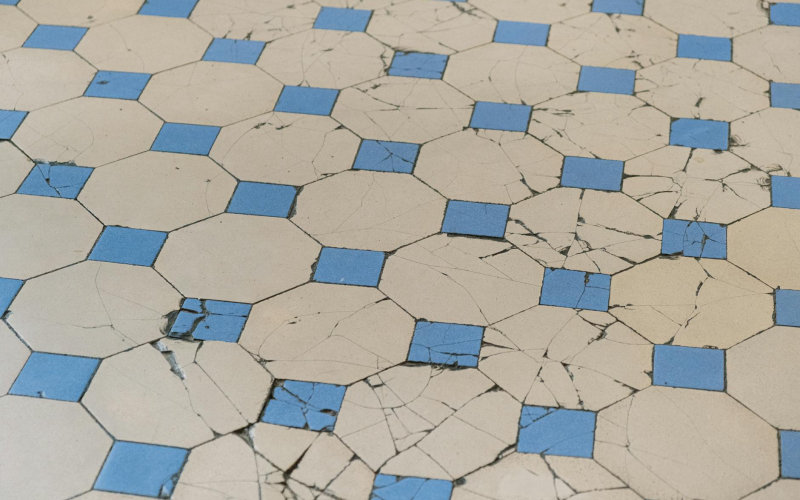

So you’ve got one cracked tile. Just one. And now you’re staring at it thinking you either have to live with it forever or tear up half the bathroom floor to fix it. Neither of those is true.
I’ve been doing home repairs and writing about them since 2012, and honestly? This is one of the most satisfying fixes you can tackle yourself. The whole challenge is surgical precision — you’re not demolishing anything. Think of it as a transplant. One bad tile out, one good tile in, and if you do it right, nobody will ever know it happened.
The catch is you can’t be sloppy. Rushing this job is exactly how you crack a perfectly good neighbor tile and turn a $15 problem into a $200 one. Here’s how to do it correctly.
What You’ll Need Before You Start
Don’t wing the tool list. Seriously.
You’ll need a grout saw or oscillating multi-tool (the Dremel MM50 is my personal go-to), a cold chisel, a hammer, a putty knife or floor scraper, tile adhesive or thin-set mortar, a replacement tile, grout that matches your existing floor, a grout float, and a sponge.
The replacement tile is where most people stumble. If your floor is older than 10 years, that specific tile might be discontinued. Check the original tile box if you still have it — manufacturers stamp lot numbers on the side. Home Depot and Floor & Decor both have staff who can help you cross-reference discontinued tiles by pattern and dimension. Bring a photo and one tile shard.
And buy slightly more grout than you think you need. A 2021 survey by the National Tile Contractors Association found that color-matching mistakes on grout are the number one reason DIY tile jobs look obviously patched. Get the right color or go a shade darker — it hides variation better.
Step 1 — Remove the Grout First
This step is non-negotiable. Skip it and try to pop the tile out without clearing the grout joints, and you will crack the adjacent tiles. Guaranteed.
Use your grout saw or oscillating tool to cut along all four grout lines surrounding the broken tile. Go slow. You’re cutting through the full depth of the grout — usually around 1/8 to 3/16 of an inch — without letting the blade wander onto the neighboring tile’s surface.
For ceramic and porcelain floors, an oscillating tool with a carbide grout blade handles this in about 10 minutes. Natural stone? Go manual with the grout saw. Stone chips easier and you need more control.
Step 2 — Break and Remove the Damaged Tile
Here’s where it gets a little satisfying. Place your cold chisel near the center of the broken tile (not the edge — never start at the edge) and tap with your hammer to fracture it further into smaller pieces. Work from the middle outward.
Smaller chunks. Easier removal. That’s the whole logic.
Once the tile is in pieces, use your putty knife or chisel to pry them up. If your tile was set with epoxy adhesive — common in older 1990s renovations — expect resistance. Soak a rag in acetone and let it sit on stubborn adhesive for about 5 minutes before scraping. It helps.
The goal is a clean, flat substrate. Any old mortar lumps or adhesive ridges left on the subfloor will cause your new tile to sit higher than the surrounding ones. Use your scraper to get the floor as flat as possible.
Step 3 — Prep the Surface
Sweep out all the debris and dust from the empty cavity. And if there’s any damaged cement board or crumbling subfloor underneath, fix that before you set the new tile — otherwise you’ll crack the replacement within a year from flex underneath it.
I once patched a tile in my sister’s kitchen without checking the subfloor properly. Eighteen months later, same spot, new crack. Lesson learned the hard way.
Dry-fit your replacement tile before applying any adhesive. Set it in the hole and check that it’s flush with the surrounding floor. Sits too low? Build up with a thin layer of thin-set. Sits too high? Scrape down more adhesive from the subfloor.
Step 4 — Set the New Tile
Mix your thin-set mortar to a peanut butter consistency — not soupy, not crumbly. Spread it evenly into the cavity using your putty knife or a notched trowel. For a single tile, a 3/16-inch V-notch trowel works well.
Press the replacement tile firmly into place. Wiggle it slightly to collapse any air pockets underneath. Then use a rubber mallet to tap it level with the surrounding floor. A short piece of 2×4 laid across the new tile and the surrounding ones helps you feel any unevenness before the mortar sets.
Let it cure for at least 24 hours. Don’t walk on it. Don’t put furniture back. Just leave it alone.
Step 5 — Regrout and Finish
Once the mortar’s fully cured, you’re ready to grout. Mix according to the package directions — unsanded grout for joints under 1/8 inch, sanded for anything wider.
Apply the grout with a rubber float, pressing firmly into the joints at a 45-degree angle. Work in small circles. Then wipe away the excess with a damp sponge before it dries. Rinse the sponge constantly, because grout haze is real and annoying to remove after the fact.
Let it cure for 72 hours minimum before getting it wet. And if you want to be smart about it, apply a grout sealer after curing — especially in bathrooms. One coat of Aqua Mix Sealer’s Choice Gold (about $18 at tile supply stores) extends grout life dramatically.
Bottom Line
Here’s something nobody tells you: the most important moment in this whole repair happens before you even touch a tool. It’s when you’re buying the replacement tile. A perfect installation technique won’t save you if the replacement tile is 1mm thicker than the originals — and tile thickness actually varies between manufacturers for the same nominal size. When you go tile shopping, bring your old tile shard and physically stack the replacement against it in the store. Thickness match matters more than color match in most cases, because grout can hide a slight color difference but nothing hides a tile that’s proud of the floor by 2mm. That’s the detail that separates a repair that’s invisible from one that’s obvious forever.
Frequently Asked Questions
Can I replace a broken floor tile without any special tools?
Technically yes, but it’s harder and riskier. A basic cold chisel, hammer, and manual grout saw can get the job done — but without an oscillating tool, you’ll need to be extra patient removing grout to avoid cracking neighboring tiles.
How do I match old grout color that’s been on my floor for years?
Aged grout is darker and dirtier than fresh grout. Buy a color that’s one shade darker than what you think matches. You can also mix in a tile grout colorant — Polyblend makes one — to dial in the tone more precisely.
What if I can’t find the same tile anywhere?
Replace the broken tile with a contrasting accent tile intentionally — a different color or pattern that looks deliberate. It’s a design choice, not a patch. Plenty of people have done this and it actually looks creative rather than desperate.
How long does the whole repair take?
The physical work is about 2 to 3 hours spread across two days — one day to remove and set, one day to grout after the mortar cures. The waiting is the hard part.
Photo by cottonbro studio on Pexels

