
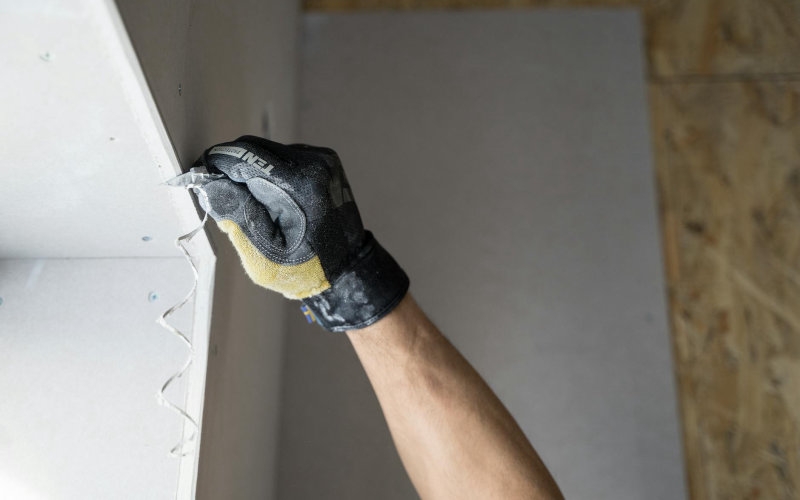

I’ve patched probably 200+ holes in drywall over the years. Some came out clean — repairs I’m genuinely proud of. Others were disasters I had to redo three times before they looked halfway decent. And every single mistake I made back then? I still see beginners making them constantly.
Here’s the thing about drywall repair: it looks deceptively simple. Slap some compound on, sand it, paint it. Done, right? Wrong. There’s a reason professional finishers spend years developing their technique, and it’s not because the work is complicated. It’s because the details matter enormously, and most beginners skip them entirely.
So if you’ve patched a wall that still looks lumpy under paint — or you’re about to tackle your first repair and want to actually nail it — these are the mistakes worth knowing upfront.
Mistake #1: Using Only One Coat of Joint Compound
This one gets almost everybody. You fill the hole, it dries, you sand, you paint — then you step back and see this subtle but maddening dent under your freshly painted wall. Infuriating.
Joint compound (called “mud” in the trade) shrinks as it dries. Sometimes 10-15% depending on humidity and how thick you applied it. You need at least three coats on anything larger than a nail hole: a base coat to fill, a second coat to build out, and a finish coat that feathers wide and thin across the surrounding surface.
Each coat needs to dry completely before the next one goes on. In humid climates or during winter with lousy airflow, that’s easily 24 hours per coat. Don’t rush it. Just don’t.
Mistake #2: Skipping Mesh Tape on Larger Holes
For holes bigger than about 3 inches, you need structural reinforcement. Full stop.
A lot of beginners — I was absolutely one of them — just jam compound into a bigger hole and call it finished. What happens next is the repair cracks within weeks, sometimes days, because there’s nothing holding the mud together as the wall flexes. Self-adhesive fiberglass mesh tape costs about $5 at Home Depot and completely solves this problem.
For holes over 6 inches, you’re honestly better off cutting out the damaged section and screwing in a new drywall patch with proper backing. The California Patch method (where you use the paper face of the drywall itself as built-in tape) works beautifully for medium-sized holes in the 4-6 inch range. Look it up if you haven’t seen it — it’s genuinely clever and saves a lot of headache.
Mistake #3: Sanding Too Early or Too Hard
Sanding wet compound is a huge mistake. It doesn’t smooth out — it tears and drags, leaving gouges that are worse than what you started with.
Your compound needs to be completely white with no gray or dark patches anywhere before you touch it with sandpaper. And when you do sand, you’re not trying to aggressively remove material. You’re just knocking down high spots. Light pressure, circular motion, 120-grit to start, then 150 for final smoothing.
What I actually do now: I use a sanding sponge for final feathering instead of paper. It’s less likely to create flat spots, and you get way more tactile feedback about where things are still uneven. Worth trying.
Mistake #4: Not Priming Before Painting
So you’ve done your coats, sanded everything smooth, and you’re eager to slap paint on. This is exactly where people blow the whole repair.
Raw joint compound is extremely porous. It soaks up paint unevenly compared to the surrounding wall, which creates what’s called “flashing” — a dull, matte spot that’s visible even when the color matches perfectly. You’ve probably seen this on walls and wondered why the patch is still so obvious. That’s why.
A coat of drywall primer (PVA primer works great — Zinsser and Kilz both make solid versions for under $15) seals the compound and gives you a uniform surface for your topcoat. Two coats of paint over primer and the repair becomes genuinely invisible. Skip the primer and you’ll end up repainting twice anyway. So just use the primer.
Mistake #5: Using the Wrong Compound for the Job
Not all joint compound is the same thing. Buying the wrong one is a classic mistake beginners make without even knowing there was a choice.
Pre-mixed all-purpose compound is fine for most repairs, but it takes longer to dry and shrinks more. If you need a quick repair, a setting-type compound (like Durabond 45 or 90 — the number is approximate working minutes) is superior. It hardens chemically rather than drying, so it barely shrinks at all and you can recoat in under 2 hours.
The downside of setting compound? It’s harder to sand. So I typically use it for the base coat on bigger repairs, then switch to lightweight all-purpose for the finish coats where smooth sanding actually matters.
Mistake #6: Applying Compound Too Thick in One Pass
Thick application cracks. Always. It’s just physics — moisture evaporates from the outer surface while the interior is still wet, stress builds up, and the surface splits.
Keep each coat thin. Thinner than you think you need to. Your base coat should fill the hole but sit slightly below the wall surface. Second coat builds up to flush. Third coat goes wider and thinner than the repair itself, blending into the surrounding drywall paper by at least 6-8 inches on each side.
That feathering step is what separates a repair that disappears from one you can spot from across the room. It really is that important.
Mistake #7: Ignoring Texture Matching
You’ve got a smooth repair on a wall with orange peel or knockdown texture. Congratulations — it’s still going to look wrong.
Texture matching is genuinely the hardest part of drywall repair for most people. But it’s not mysterious. Orange peel texture comes from an air compressor and texture spray, or from a roller with a specific nap thickness. Knockdown gets applied with a spray and then “knocked down” with a knife while still wet.
Homax makes aerosol texture cans in multiple patterns (orange peel, splatter, knockdown) that run about $8-12 and work surprisingly well for small repairs. For larger areas, practice your spray pattern on cardboard first. Seriously — cardboard first. Every time.
Bottom Line
Here’s something I’ve never actually seen anyone else say about drywall repair: the most important step is the one you take three days after you think you’re done. Walk past the repaired wall at different times of day — morning light raking across it, afternoon sun, lamps on at night. Light reveals imperfections that a straight-on inspection misses completely.
Most failed repairs aren’t bad because the technique was wrong. They’re bad because the person declared victory too soon and painted before genuinely inspecting the work. Give your repair the 72-hour light test before you pick up a brush. You’ll catch things you’d seriously regret missing.
Frequently Asked Questions
How long should I wait between drywall compound coats?
At minimum, wait until the coat is completely dry and white throughout — no gray areas anywhere. In normal conditions (70°F, moderate humidity) that’s roughly 24 hours per coat. A fan speeds things up, but don’t apply heat directly to the compound.
What’s the best joint compound for small drywall repairs?
For small nail holes or cracks, lightweight all-purpose pre-mixed compound is ideal. It feathers easily and sands smooth. For holes larger than 3 inches, consider Durabond 45 (setting compound) as your first coat to minimize shrinkage.
Why does my drywall patch show through paint?
Almost always because you skipped primer. Raw compound absorbs paint differently than the surrounding wall, creating those visible dull spots called flashing. One coat of PVA drywall primer before painting and the problem disappears entirely.
Do I need to texture my drywall repair?
Only if your existing wall has texture. On smooth walls, proper feathering and priming is enough. But on textured walls, skipping texture matching is one of the most obvious drywall repair mistakes beginners make — even a technically perfect smooth repair will look completely wrong against a textured surface.
Photo by Jimmy Nilsson Masth on Pexels

